The Shiant Islands

Geology
The Shiant Isles are defined by their geology. Their form, stability, soils and cliffs are the product of volcanic processes that took place around 60 million years ago, during the opening of the North Atlantic. What is visible today is the eroded remnant of a much larger igneous system, revealed gradually through time.
This deep geological history governs how the islands function as land. It shapes where soil can accumulate, where vegetation can take hold and where seabirds are able to nest. Understanding this framework is essential to understanding why the islands are both resilient and limited.


Formation
The islands are composed primarily of Paleogene basalt intrusions emplaced into older sedimentary rocks. As molten material cooled slowly beneath the surface, it fractured into characteristic columnar structures. Over millions of years, erosion removed surrounding softer material, exposing the harder basalt cores that now form the islands.
This places the Shiant Isles within the wider North Atlantic Igneous Province, alongside Skye and Mull. However, such basaltic geology is rare in the Outer Hebrides, making the Shiants geologically distinctive within the region.
WILD NATURE :: MINIMAL FOOTPRINT
Basalt Columns and Cliffs
Columnar basalt gives the islands their distinctive stepped cliffs and vertical faces. These formations are visually striking but also structurally significant. Fracture patterns influence water movement, weathering, and long-term stability, while cliff ledges provide essential nesting habitat for seabirds.
Although the rock appears solid and enduring, it is subject to continual, incremental change. Freeze–thaw action, salt crystallisation, and wave erosion slowly widen joints and fractures, reshaping the cliffs over time.
Soils, Stability,
and Exposure
::
Soil formation on basalt is slow and uneven. On the Shiant Isles, soils occur only where material has accumulated in sheltered pockets or depressions. In many areas, soil depth is minimal, often only a few centimetres.
This creates a landscape highly sensitive to disturbance. Compaction and erosion occur quickly, while recovery is prolonged. Persistent wind, salt spray and heavy rainfall further limit the land’s capacity to absorb change.


Geology and Ecology
::
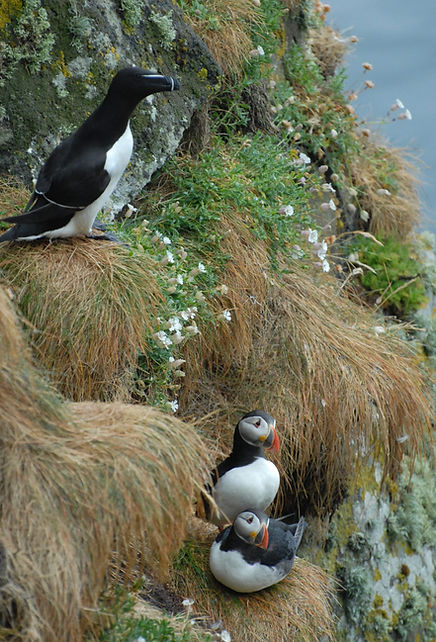
The close relationship between geology and ecology is evident across the islands. Burrowing seabirds depend on the limited areas of stable soil, while cliff-nesting species rely on the integrity of basalt ledges. Vegetation patterns closely follow variations in rock type, shelter and drainage.
Human use has always been constrained by this geological framework. Movement concentrates along narrow routes where footing allows passage, increasing the potential for erosion over time.
©Jim Lennon
Scale and Restraint
::
Geology places human activity in perspective. The processes that formed the Shiant Isles operate over timescales far beyond human planning or correction.
Damage can occur rapidly, but repair, if possible at all, unfolds over decades or centuries.
Seen in this context, restraint is not a management preference but a geological necessity.
Sources & Further Reading
::
-
Geological Conservation Review – Shiant Isles
-
JNCC – GCR Site Account: Shiant Isles
-
British Geological Survey – Palaeogene igneous geology of north-west Scotland
-
NatureScot – Conservation and Management Advice for the Shiant Isles SPA
-
Hebridean Connections – Garbh Eilean (Shiant Isles)
-
Nicolson, A. Sea Room; A Seabird’s Cry
